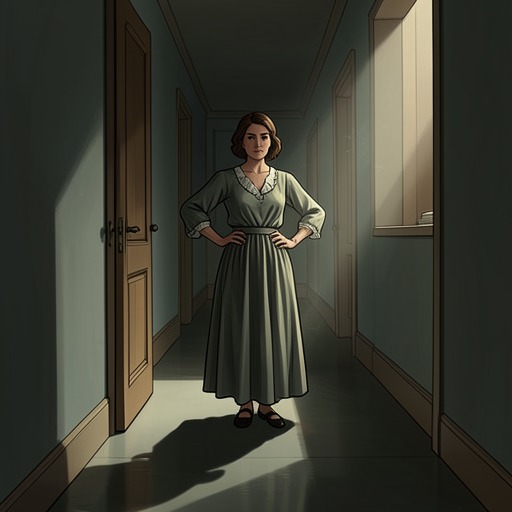
Prescribed femininity
The Second SexPrescribed femininity describes the social training that makes female passivity appear natural and women’s lives seem destined for pleasing others, domestic work, and dependence on men. Simone de Beauvoir presents it instead as an imposed condition: children are taught different ways of inhabiting their bodies and pursuing the world, and the resulting constraints shape girls’ prospects long before adulthood. The role is maintained not only by explicit rules but also by ordinary lessons, games, expectations, and repetitive labor.
Definition and Formation
For Simone de Beauvoir, femininity is not a fixed biological fate. A girl is an autonomous individual, but she grows up in a world that encourages her to understand herself as an object for others and to relinquish the freedom through which she might explore and act. The resulting passivity is learned from the earliest years, through social treatment and education rather than determined by anatomy.
The contrast begins in children’s activities. Boys are encouraged to climb, fight, compete, and test their strength; through such actions they learn to treat their bodies as instruments for acting on the world. Girls, by contrast, are steered away from rough games and taught to make themselves pleasing. The difference is not that girls lack curiosity or initiative, but that their upbringing places self-assertion in conflict with the conduct expected of them.
Childhood Training and the Making of a Role
The instruction is conveyed through a whole environment. Girls are given other girls as companions and female teachers, while books and games introduce them to the future assigned to them. They learn cooking, sewing, and housework alongside rules for dress, grooming, charm, and modesty. Fancy, uncomfortable clothes must be kept in order; hair and posture are managed; spontaneous movement is corrected, strenuous exercise discouraged, and fighting forbidden. The child is prepared to become both a servant and an object of admiration.
This training is enforced by repeated judgments about what a girl should look like and how she should move. A girl is told not to behave like a tomboy and must suppress unstudied gestures in favor of grace. Even when education and sport become more available, achievement carries an additional condition: she must succeed without seeming to lose her femininity. Social acceptance is thus made conditional on performing the role even as girls are offered new opportunities.
The doll participates in this formation without causing it by itself. Girls and boys can both project themselves onto toys; what matters is the wider pattern that gives the doll its particular significance for girls. In play, a girl may treat the doll as both a double and a child, rehearsing authority and care in a world where she has been taught that child-rearing belongs to women. That imaginative activity does not demonstrate an innate maternal instinct: the child’s observations, stories, and instruction have already connected women with childcare.
Unequal Freedom and the Approach of Adolescence
The role’s effects are visible in the unequal permission children receive to explore and test their capacities. At about thirteen, boys are encouraged to develop competition and force, while girls begin to give up rough play. Some sports may remain open to them, but, in the account, organized sport does not offer the same everyday lesson as spontaneous climbing or fighting. Many girls are not given athletic training at all; climbing and fighting are forbidden. They are consequently denied ordinary chances to challenge limits and experience themselves as acting freedoms in the world.
These restrictions matter beyond physical activity. A boy can meet a challenge through action and experience his agency concretely; a girl is more often required to remain passive when she encounters opposition. The book compares this inability to express revolt through action with other conditions in which people are denied the means to resist being treated as objects. Its point is not that physical force governs ordinary adult life, but that the permission to act, risk, and confront others helps make freedom tangible. Prescribed femininity withholds that permission from girls.
Childhood’s imagined future gives way to a sharper constraint at puberty. The girl, once able to experience herself in present activities as an autonomous individual, begins to feel the future role settling into her body. The future is no longer remote: the adult life expected of her seems already prepared, while the present offers occupations rather than ends she can claim as her own. Youth becomes a period of waiting for a man, imagined as the source of accomplishment, security, and escape. In this way, femininity links childhood training to an adulthood organized around male approval and dependence.
Work, Marriage, and Repetitive Time
Prescribed femininity also shapes the division of labor. Childbirth and nursing are natural functions, Simone de Beauvoir argues, rather than projects through which a person creates new ends. When domestic work is treated as the work compatible with motherhood, women are confined to tasks that repeat rather than open a future. Against this stands the activity of the maker, whose projects extend beyond immediate necessity and alter the world. The contrast is not between women’s and men’s inherent capacities, but between the social meanings and opportunities attached to their work.
The concrete burden appears in the account of French peasant women. A woman may share a household’s responsibilities, interests, and property, and may possess considerable moral authority; nevertheless, the work assigned to her is extensive. She tends gardens and animals, cleans, sows, plows, weeds, harvests, and works in the fields, while also preparing meals, managing the household, and caring for children. Her day begins before the men’s first meal and continues through fieldwork and evening mending or cleaning. With little time for her health, pregnancy included, she may be worn down by illness and labor, while the men have opportunities on Sundays and fair days to visit the city, meet friends, play cards, hunt, or fish. Authority within the home does not cancel the unequal distribution of work or leisure.
The same structure makes paid work difficult to reconcile with family responsibilities. Childcare and housekeeping remain almost exclusively women’s burden, while birth control is not reliably available to all and abortion is officially forbidden in the circumstances described. Women must therefore manage work alongside obligations that are not similarly imposed on their spouses. The right to work can offer a route away from dependence, but for many workers it remains exhausting labor rather than a secure gain in dignity, freedom of behavior, and economic autonomy.
Marriage further reinforces the role by directing girls toward a future organized around a husband. Parents continue to raise daughters for marriage rather than personal development; girls may come to desire that future themselves, while receiving less specialized training and committing themselves less fully to a profession than their brothers. The resulting professional disadvantage then strengthens the appeal of marriage, tightening a circle between inadequate preparation and dependence. The fantasy of a Prince Charming promises a sudden rise in fortune or social position, but it can divide a woman’s effort and interests; the possibility of a lucky marriage is presented as an alluring exception against the ordinary need for independent work.
Consequences and Critical Significance
Prescribed femininity works by turning restrictions into apparent preferences. Girls are taught that to please men they must yield, avoid taking the initiative, and suppress traits characterized as too bold, intellectual, or independent. Mothers may reinforce the instruction by warning daughters not to approach boys as companions or make their interest too evident. A girl who tries to act with the directness encouraged in boys may be discouraged, while the culturally approved feminine ideal rewards weakness, docility, and passivity. What appears to be a personal choice is formed within unequal expectations and rewards.
This role also imposes a double demand. Girls are increasingly encouraged to pursue education and sports, yet their success is more readily excused and they must still demonstrate that they have not ceased to be feminine. They are asked to develop abilities while remaining within a standard that can penalize the independence those abilities require. Prescribed femininity therefore adapts when opportunities expand: it need not exclude girls from every activity if it can continue to make their accomplishment conditional on gendered conduct.
The consequences can be read in time as well as opportunity. The book contrasts open-ended projects with the recurring labor of the household, where dishes, dust, and clothing must be dealt with again after each day. It likens the housewife’s work to the torment of Sisyphus: the effort consumes time but does not secure a lasting victory, because the same tasks return. A girl hearing her mother clean may recognize that the future she once imagined as an ascent can instead become a succession of identical days. The role thus narrows not only what women are permitted to do but also the future they can experience as their own.
The critique is anchored in existentialist morality. Every person seeks to realize freedom through projects and movement toward an open future; when a person is confined to immanence, freedom is reduced to a fixed condition. Women’s drama, as Simone de Beauvoir frames it, is the conflict between their claim to exist as autonomous subjects and a situation that defines them as inessential in relation to men. Prescribed femininity names one of the processes that makes this contradiction seem natural—and that must be challenged if women are to pursue independence within the conditions imposed on them.